

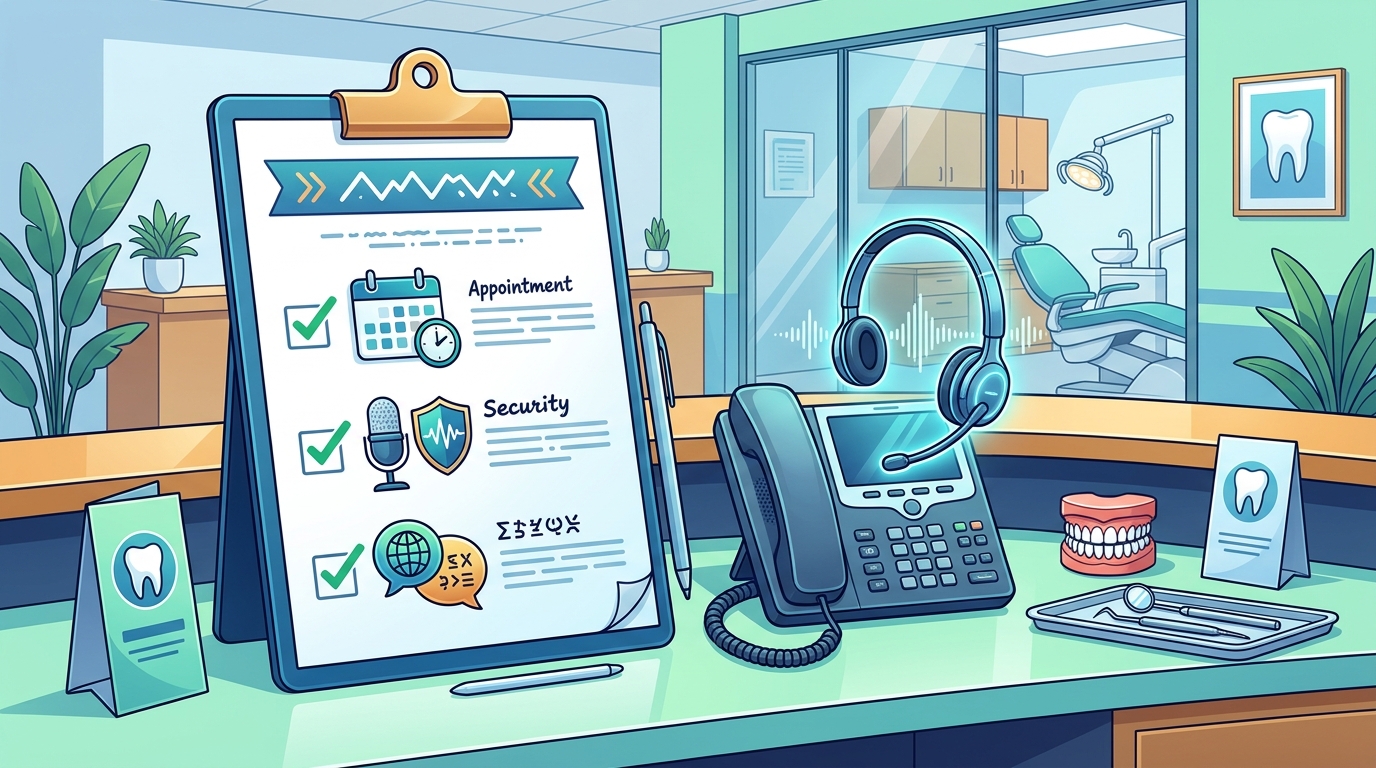
Dental practices must verify appointment booking accuracy, call recording consent, and multilingual support before deploying an AI answering service. These three features determine whether the system protects patient data, captures revenue, and serves diverse communities effectively. This guide provides a detailed checklist for evaluating these critical capabilities in 2026.
Appointment Booking Accuracy
Appointment booking accuracy is the ability of an AI system to correctly interpret patient requests and update the practice management calendar without human intervention. In a dental setting, a booking error can lead to double-booking, missed hygiene appointments, or lost revenue. Practices should verify that the AI integrates directly with their practice management system (PMS) such as Dentrix, Eaglesoft, or Open Dental.
Calendar Synchronization and Conflict Resolution
The AI must not only read the calendar but also write to it in real-time. Verify that the system checks for provider availability, room availability, and equipment constraints simultaneously. A robust AI receptionist should detect conflicts before confirming an appointment. If the AI books a cleaning for a provider who is already scheduled for a root canal, the system must flag the error and either reschedule or transfer the call to a human agent.
Service-Specific Logic
Dental appointments vary in duration and complexity. A standard cleaning takes 30 minutes, while a crown preparation may take 90 minutes. The AI must understand these durations to prevent scheduling overlaps. Verify that the system supports custom appointment types with specific time blocks. Additionally, the AI should ask qualifying questions, such as insurance verification or emergency status, before booking. This ensures that the appointment is not only scheduled but also properly categorized for billing and clinical workflow.
Call Recording Consent
Call recording consent is the legal and ethical requirement to inform patients that their conversation is being recorded before any audio is captured. In the United States, many states follow two-party consent laws, meaning both the caller and the business must agree to the recording. Dental practices must ensure their AI system complies with these regulations to avoid legal liability and maintain patient trust.
Automated Disclosure and State-Specific Compliance
The AI must play a clear, audible disclosure at the start of every call. This message should state that the call is being recorded for quality assurance and compliance purposes. Verify that the system can adjust the disclosure language based on the caller's location. For example, a practice in California (one-party consent) may have different requirements than a practice in Florida (two-party consent). The AI should detect the caller's area code or use the practice's location to determine the appropriate consent script.
Data Retention and Security
Consent is not just about the initial disclosure; it also involves how the data is stored. Verify that the AI provider offers encrypted storage for call recordings and transcripts. Dental practices handle sensitive health information, so the system must comply with HIPAA regulations. This includes signing a Business Associate Agreement (BAA) with the AI vendor. The provider should offer clear data retention policies, allowing practices to delete recordings after a specified period. Transparency in data handling is a critical feature that distinguishes a compliant AI service from a risky one.
Multilingual Support
Multilingual support is the capability of an AI system to detect the caller's language and respond naturally in that language. Dental practices in diverse communities often serve patients who speak Spanish, Arabic, Mandarin, or other languages. A monolingual AI that only speaks English will frustrate non-English speakers and may lead to missed appointments or misunderstandings about treatment plans.
Language Detection and Switching
Verify that the AI can automatically detect the language of the caller within the first few seconds of the call. The system should switch seamlessly to the detected language without requiring the patient to press a button or repeat themselves. Advanced systems support code-switching, where a patient might mix English and Spanish in a single sentence. The AI voice agent should handle this fluidly to maintain a natural conversation flow. This capability is essential for practices in areas with high linguistic diversity.
Accuracy in Medical Terminology
General translation tools often struggle with medical terminology. Verify that the AI is trained on dental-specific vocabulary in the supported languages. For example, the AI should correctly understand and respond to terms like "toothache," "gum bleeding," or "crown sensitivity" in Spanish or Arabic. Inaccurate translation of medical symptoms can lead to misdiagnosis or inappropriate triage. The AI should also be able to book appointments and answer FAQs in the patient's preferred language, ensuring that no patient is excluded from care due to language barriers.
Feature Comparison Table
| Feature | Basic AI Service | Advanced Dental AI (e.g., CX Bridge) |
|---|---|---|
| Booking Accuracy | Books into generic calendar | Integrates with PMS, checks provider/room conflicts |
| Recording Consent | Static disclosure, no state logic | Dynamic disclosure, HIPAA-compliant, BAA signed |
| Multilingual Support | English only or basic translation | Auto-detection, dental-specific terminology, code-switching |
| Human Handoff | Transfers to voicemail | Warm transfer with full context summary |
Key Takeaways
- Verify that the AI integrates directly with your practice management system to ensure real-time calendar synchronization.
- Ensure the AI checks for provider, room, and equipment conflicts before confirming any appointment.
- Confirm that the system plays a clear recording disclosure that complies with your state's consent laws.
- Require a signed Business Associate Agreement (BAA) to ensure HIPAA compliance for all recorded data.
- Test the AI's ability to detect and switch languages automatically without user input.
- Verify that the AI understands dental-specific terminology in the languages it supports.
- Check if the AI can perform a warm transfer to a human agent with a full context summary.
- Ensure the provider offers transparent data retention and deletion policies for call recordings.
Frequently Asked Questions
How does an AI receptionist handle double-booking errors?
Is it legal to record dental patient calls?
Yes, provided you comply with state consent laws. In two-party consent states, you must inform both parties that the call is being recorded. The AI should play a disclosure at the start of the call. You must also sign a BAA with the AI provider to ensure HIPAA compliance.
Can the AI book appointments for specific providers?
Yes, advanced AI systems can book appointments for specific dentists or hygienists. The AI asks the patient for their preference and checks the specific provider's calendar. This ensures that the patient sees the clinician they requested, if available.
What happens if the AI does not understand the patient's language?
If the AI cannot detect or process the patient's language, it should transfer the call to a human agent or a multilingual support line. The AI should not guess or provide inaccurate translations. A warm transfer with a note about the language barrier ensures the human agent is prepared to assist.
How much does an AI answering service for dental practices cost?
Costs vary by provider and usage. Some services charge per minute, while others offer per-seat pricing. For example, CX Bridge offers a free plan and paid tiers with custom pricing for larger teams. This model is often more predictable than per-minute billing for high-volume practices.
Does the AI need to be HIPAA compliant?
Yes, any AI service that handles patient health information must be HIPAA compliant. This includes encryption of data in transit and at rest, access controls, and audit logs. You must sign a Business Associate Agreement with the provider to ensure they are legally bound to protect patient data.
Conclusion
Selecting the right AI answering service for your dental practice requires careful verification of booking accuracy, legal compliance, and language capabilities. By focusing on these three core features, you can ensure that your AI system enhances patient experience and operational efficiency. CX Bridge offers a specialized solution for dental practices, combining these features with seamless human handoff and industry-specific integrations. Start with a pilot to test these capabilities on your own calls and verify that the system meets your specific needs.