

AI booking improves dental practice efficiency by reducing average handle time and increasing appointment fill rates. Unlike human staff who can only answer one call at a time, AI agents handle concurrent calls instantly. This eliminates the 30-40% of missed calls that typically result in lost revenue. The efficiency gain comes from immediate scheduling, automated qualification, and 24/7 availability without overtime costs.
The Cost of Human-Only Call Handling
Traditional dental front desks operate under a strict one-call-at-a-time constraint. When a receptionist is checking in a patient or explaining a bill, incoming calls go to voicemail. Data indicates that the average small business misses 30-40% of incoming calls. In a dental context, this means a significant portion of potential patients never get a chance to book. The human model also suffers from fatigue and multitasking errors, leading to longer hold times and higher abandonment rates.
Human answering services, while helpful, introduce latency. They take messages and promise callbacks, but the caller has often moved on by then. The efficiency loss is not just in missed calls but in the administrative overhead of processing voicemails and returning calls. This manual workflow consumes valuable staff time that could be spent on patient care or revenue-generating tasks.
How AI Agents Accelerate Scheduling
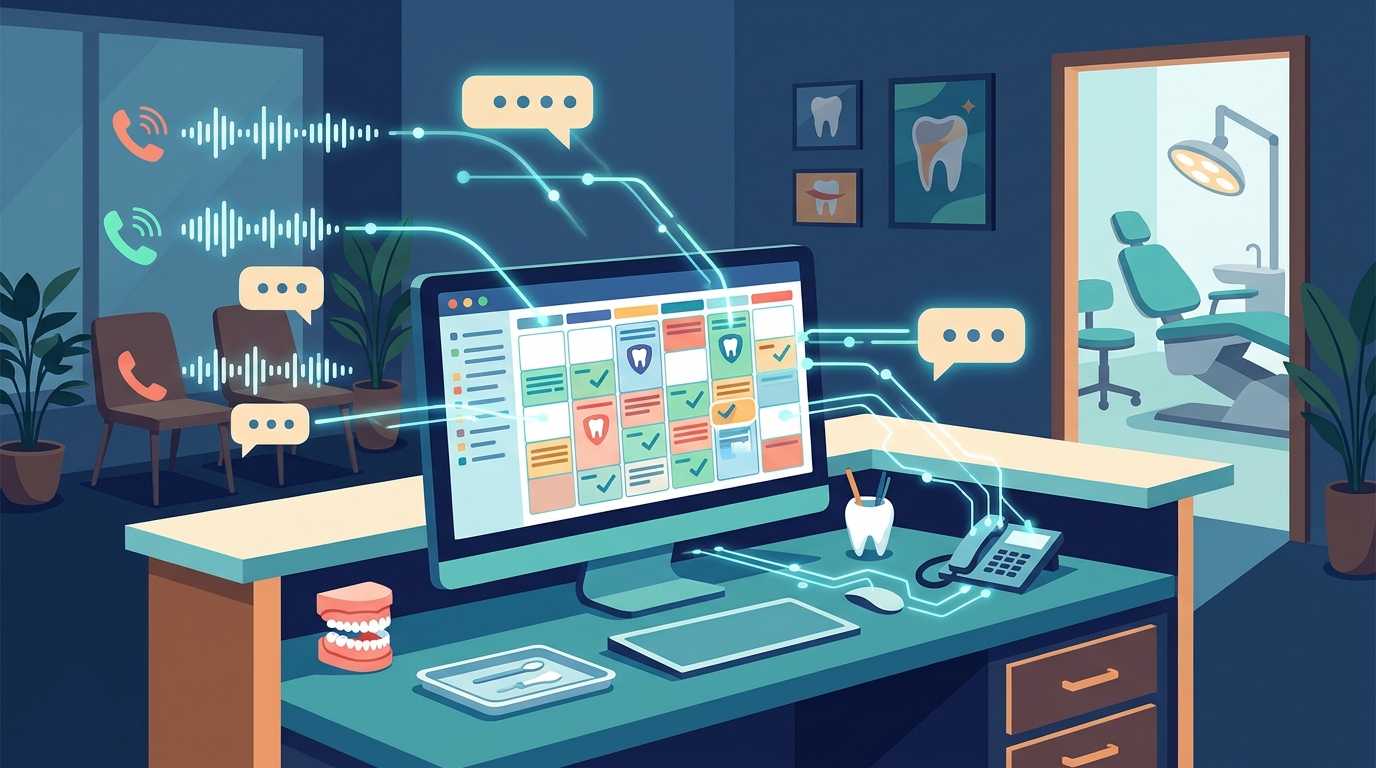
An AI voice agent is a software system that uses natural language processing to understand caller intent and execute actions like booking appointments. It operates on a parallel processing model, meaning it can handle dozens of calls simultaneously without degradation in service quality. For a dental practice, this translates to immediate access to the calendar. The AI checks provider availability in real-time and offers specific slots to the caller during the conversation.
This immediacy is the primary driver of efficiency. When a caller asks for a cleaning, the AI does not just take a message; it books the appointment. It confirms the time, sends an SMS confirmation, and updates the practice management system. The entire transaction happens in under three minutes. This speed reduces the friction that often causes callers to abandon the booking process. The result is a higher conversion rate from inbound call to scheduled appointment.
Quantifying the Efficiency Lift
The efficiency improvement can be measured in three key metrics: handle time, capacity, and conversion. First, average handle time drops significantly. Human agents often spend 5-8 minutes on a booking call due to manual data entry and verification. AI agents complete the same task in 2-3 minutes. Second, capacity increases from one concurrent call to unlimited. A single AI agent can handle the call volume of a full-time receptionist during peak hours without hiring additional staff. Third, conversion rates improve because the appointment is secured during the initial contact.
Consider a practice receiving 50 calls per day. If 40% are missed or delayed, that is 20 lost opportunities. With AI, those 20 calls are answered and booked. At an average value of $500 per patient, this represents $10,000 in recovered revenue per day. The efficiency gain is not just about speed; it is about capturing value that was previously lost to operational constraints. This direct impact on the bottom line is what makes AI booking a critical efficiency tool for modern dental practices.
Reducing Administrative Overhead
Efficiency is also about reducing the hidden costs of manual workflows. Human booking requires constant context switching. Staff must move between the phone, the computer, and the front desk. This fragmentation leads to errors and slower processing. AI agents handle the routine data entry and verification automatically. They pull patient records, verify insurance details, and update the calendar without human intervention. This frees up staff to focus on complex tasks that require empathy and judgment.
The reduction in administrative overhead also improves staff satisfaction. When employees are not constantly interrupted by phone calls, they can work more effectively and with less stress. This leads to lower turnover and higher quality patient interactions. The AI handles the repetitive, high-volume tasks, while humans handle the high-value, low-volume interactions. This division of labor is the core of the efficiency model. It allows the practice to scale its phone handling without scaling its headcount.
Implementation and Integration
Implementing AI booking requires integration with existing practice management systems. The AI must have read and write access to the calendar and patient records. This ensures that the appointments it books are accurate and visible to the entire team. Platforms like CX Bridge offer integrations with major dental software, allowing for seamless data flow. The setup process is quick, often taking less than 48 hours. This rapid deployment means practices can start seeing efficiency gains almost immediately.
The key to successful implementation is defining clear routing rules. The AI should handle routine bookings and FAQs, while complex clinical questions or upset callers are transferred to a human. This hybrid model ensures that the efficiency gains of AI are balanced with the empathy and judgment of human staff. The result is a contact center that is both fast and friendly. It captures every lead and resolves every issue, maximizing the efficiency of every phone interaction.
Key Takeaways
- AI booking reduces average handle time compared to human staff.
- AI agents handle concurrent calls, eliminating the 30-40% missed call rate.
- Immediate scheduling during the call increases appointment fill rates.
- AI automation reduces administrative overhead, freeing staff for high-value tasks.
- The hybrid model of AI and human agents optimizes both speed and empathy.
- Implementation is rapid, with most practices live in under 48 hours.
Frequently Asked Questions
Does AI booking replace human receptionists?
No, AI booking augments human receptionists. It handles routine calls and bookings, allowing humans to focus on complex patient interactions and clinical questions. The goal is to empower staff, not replace them.
How long does it take to set up AI booking?
Most practices are live in under 48 hours. The setup involves connecting the phone line, uploading business information, and integrating with the practice management system. No special hardware or coding is required.
Can AI handle complex dental questions?
AI handles routine questions and bookings. For complex clinical questions or upset callers, it seamlessly transfers the call to a human agent with full context. This ensures that patients get the right help at the right time.
What is the cost of AI booking?
AI booking is significantly cheaper than hiring additional staff or using human answering services. It typically costs a fraction of the cost of a full-time receptionist, with no overtime or benefits expenses.
Is AI booking secure for patient data?
Yes, reputable AI platforms are HIPAA-compliant and use encrypted data transmission and storage. They sign Business Associate Agreements (BAAs) to ensure patient privacy and security.
Start Improving Your Practice Efficiency
Ready to see the efficiency gains for yourself? CX Bridge offers a two-week pilot that lets you test AI booking on your own calls. See how many more appointments you can book and how much time you can save. Contact our team to get started today. Learn more: Contact CX Bridge Book.