

For small teams, the best AI receptionist is one that offers a low-risk, two-week pilot model allowing you to test live call handling before committing to a long-term contract. This guide covers how to evaluate these pilots, verify vendor claims, understand pricing structures, and measure real-world results. We focus on practical steps for businesses with 2 to 20 employees who need to answer every call without hiring additional staff.
How to Choose the Right Pilot
Selecting an AI receptionist requires looking beyond marketing promises. A two-week pilot model is a trial period where the vendor deploys their AI on your live phone lines to handle real customer interactions. This differs from a demo, which is a scripted simulation. The goal is to see how the AI performs under pressure.
Key Differentiators
Not all pilots are created equal. A high-quality pilot includes live call handling, not just voicemail transcription. It should allow the AI to book appointments or answer FAQs directly. Look for vendors that provide a dashboard where you can listen to recordings and review transcripts immediately. If the pilot only allows you to test the AI in a sandbox environment, it does not reflect real-world performance.
Another critical factor is the handoff mechanism. Does the AI know when to stop talking and transfer the call to a human? A good pilot will demonstrate this transition seamlessly. You want to see if the AI can detect frustration or complex queries and route them to your team with context.
Questions to Ask Before Committing
Before signing any agreement, you must ask specific questions to ensure the pilot meets your operational needs. These questions help you gauge the vendor's technical maturity and support structure.
Essential Questions
- What is the setup time? Can you be live in 48 hours, or does it take weeks? Fast setup is crucial for a short pilot.
- How does the AI handle unknown questions? Does it admit it doesn't know and take a message, or does it hallucinate an answer?
- Is there a human handoff? Can the AI transfer a live call to a specific team member with a summary of the conversation?
- What integrations are supported? Does it connect to your calendar, CRM, or practice management system?
- What is the pricing model? Is it per seat, per minute, or a flat rate? Are there hidden fees for telephony or transcription?
Verifying Vendor Claims
Vendors often make bold claims about accuracy and uptime. You must verify these claims independently. A verification process is the act of confirming that a vendor's technical capabilities match their marketing materials. This involves testing the system under various conditions.
Verification Steps
First, test the AI with edge cases. Call the number and ask questions that are not in the knowledge base. See if the AI handles the ambiguity gracefully. Second, check the latency. The delay between your question and the AI's response should be under one second for a natural conversation. Third, verify the integration. If the vendor claims to book appointments, actually book one and check if it appears in your calendar correctly.
The Pilot Process Step-by-Step
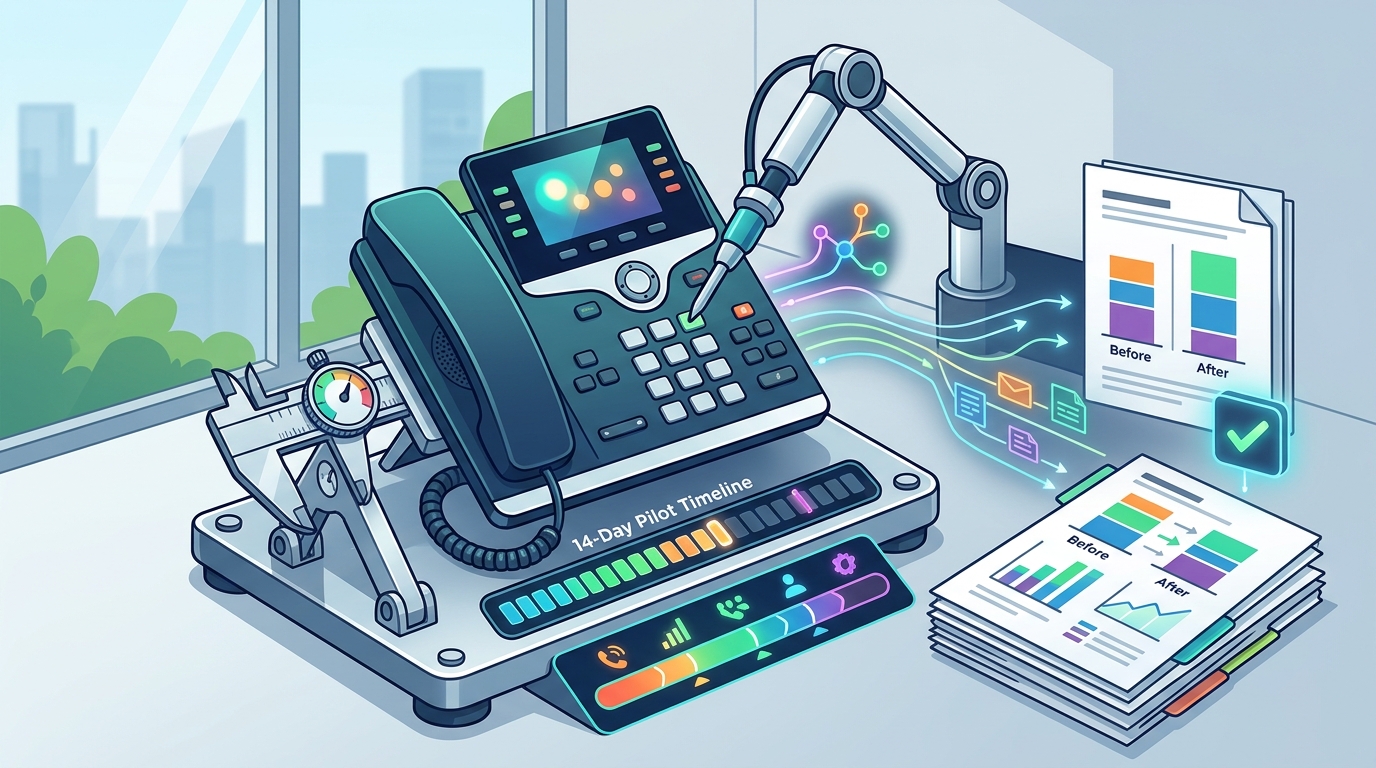
Understanding the workflow helps you prepare your team. A typical two-week pilot follows a structured sequence of events.
Phase 1: Setup (Days 1-2)
You provide your business details, hours, and common questions. The vendor configures the AI agent. You connect your phone line, often via call forwarding or a SIP trunk. This phase should take less than 48 hours.
Phase 2: Live Testing (Days 3-10)
The AI goes live. It answers calls, books appointments, and handles FAQs. Your team monitors the dashboard. You review transcripts and listen to recordings. You provide feedback to the vendor to adjust the AI's behavior.
Phase 3: Evaluation (Days 11-14)
You analyze the data. How many calls were answered? How many were booked? How many were transferred? You compare these metrics against your baseline. You decide whether to convert to a paid plan.
Understanding Pilot Costs
Cost is a major factor in choosing a pilot. Pricing models vary significantly between vendors. A hybrid pricing model is a structure that combines a fixed monthly fee per seat with a variable cost for AI usage, such as per-minute credits.
Common Pricing Structures
| Model | Description | Pros | Cons |
|---|---|---|---|
| Per-Minute | Pay for every minute of AI usage | Low cost for low volume | Unpredictable costs during spikes |
| Flat Monthly | Fixed fee for unlimited or capped usage | Predictable budget | May overpay for low volume |
| Per-Seat + Usage | Fixed fee per agent + per-minute AI cost | Predictable platform cost, scalable AI | Two line items to track |
For a small team, a per-seat model with usage credits is often the most balanced. It provides a predictable base cost while allowing you to pay for actual AI minutes used.
Common Pilot Mistakes
Many businesses fail to get value from their pilots due to avoidable errors. A pilot failure is when the trial period does not provide enough data to make a confident decision about long-term adoption.
Top Mistakes to Avoid
- Not defining success metrics: Decide in advance what a successful pilot looks like. Is it 90% of calls answered? Is it 50% of calls booked?
- Ignoring the handoff: If the AI cannot transfer calls effectively, your team will be frustrated. Test this thoroughly.
- Not updating the knowledge base: The AI is only as good as the data you give it. Keep your FAQs and policies up to date.
- Waiting too long to evaluate: Don't wait until the end of the two weeks to review data. Check in weekly to make adjustments.
AI Pilots vs. Traditional Services
Comparison Table
| Feature | AI Receptionist Pilot | Human Answering Service | In-House Receptionist |
|---|---|---|---|
| Availability | 24/7 | Limited hours | Business hours only |
| Functionality | Books, qualifies, answers FAQs | Takes messages | Books, answers, greets |
| Cost | Low ($100-$200/mo) | Medium ($300-$1,200/mo) | High ($3,000-$4,000/mo) |
| Scalability | Instant | Slow | Slow |
AI pilots offer the best combination of cost, availability, and functionality for small teams. They allow you to handle more calls without increasing headcount.
Industry-Specific Considerations
Different industries have different needs for AI receptionists. A dental practice needs to book appointments and verify insurance. A law firm needs to qualify leads and check for conflicts. A home service business needs to dispatch technicians.
Industry Examples
- Healthcare: Look for HIPAA compliance and integration with practice management systems like Dentrix or Eaglesoft.
- Legal: Look for integration with case management systems like Clio and the ability to handle conflict checks.
- Real Estate: Look for multilingual support and the ability to book viewings and follow up with leads.
Data Privacy and Compliance
Data privacy is a critical concern when using AI. A Business Associate Agreement (BAA) is a legal contract that ensures a vendor will protect your client's health information in compliance with HIPAA. If you are in a regulated industry, you must verify that the vendor signs a BAA.
Compliance Checklist
- Data Encryption: Is data encrypted in transit and at rest?
- Access Controls: Who can access the call recordings and transcripts?
- Data Retention: How long does the vendor keep your data? Can you delete it?
- Compliance Certifications: Does the vendor have SOC 2 or ISO 27001 certifications?
Regional and Local Factors
Local factors can impact the performance of your AI receptionist. Time zones, local phone number requirements, and regional dialects all play a role. If you serve multiple locations, ensure the AI can handle different local numbers and time zones.
Local Considerations
- Local Numbers: Can the AI use your existing local numbers, or do you need to port them?
- Time Zones: Does the AI understand local business hours and adjust accordingly?
When to Start a Pilot
Timing is crucial for a successful pilot. Start the pilot during a period of normal business activity. Avoid starting during a holiday or a peak season, as this may skew the results. A baseline period is a time frame before the pilot where you measure your current call handling metrics. This gives you a reference point for comparison.
Best Times to Start
- After a busy period: When your team is tired of missing calls.
- Before a hiring decision: To see if AI can replace the need for a new hire.
- After a negative review: If a customer complained about being unable to reach you.
Measuring Long-Term Results
The pilot is just the beginning. You need to measure long-term results to ensure the AI continues to provide value. Track metrics like call answer rate, appointment booking rate, and customer satisfaction. A return on investment (ROI) is the ratio of the financial gain from the AI to the cost of the AI. Calculate this monthly to ensure the AI is paying for itself.
Key Metrics to Track
- Call Answer Rate: Percentage of calls answered by the AI.
- Booking Rate: Percentage of calls that result in a booked appointment.
- Transfer Rate: Percentage of calls transferred to a human.
- Customer Satisfaction: Score from post-call surveys.
Key Takeaways
- A two-week pilot model is the best way to test an AI receptionist with low risk.
- Look for vendors that offer live call handling, not just demos.
- Verify vendor claims by testing edge cases and checking latency.
- Understand the pricing model to avoid hidden costs.
- Define success metrics before starting the pilot.
- Ensure the AI can hand off calls to humans seamlessly.
- Check for compliance certifications like HIPAA or SOC 2.
- Measure long-term results to ensure ongoing value.
Frequently Asked Questions
What is a two-week pilot model for an AI receptionist?
A two-week pilot model is a trial period where the vendor deploys their AI on your live phone lines to handle real customer interactions. It allows you to test the system before committing to a long-term contract.
How much does an AI receptionist pilot cost?
Costs vary by vendor. Some offer free trials, while others charge a reduced rate. A typical paid pilot might cost $100 to $200 per month, depending on the pricing model.
Can the AI book appointments during the pilot?
Yes, if the vendor supports calendar integration. The AI can check availability and book appointments directly into your calendar during the call.
What happens if the AI cannot answer a question?
It should take a message or transfer the call to a human. A good AI will admit it doesn't know and offer to connect you with a team member.
Is the AI HIPAA compliant?
Some vendors are HIPAA compliant and will sign a Business Associate Agreement (BAA). You must verify this if you are in the healthcare industry.
How long does setup take?
Setup typically takes less than 48 hours. You provide your business details, connect your phone line, and configure the AI agent.
Can I cancel the pilot at any time?
Yes, most pilots do not require a long-term contract. You can cancel at the end of the two-week period if you are not satisfied.
Conclusion
Choosing the right AI receptionist is a critical decision for small teams. A two-week pilot model offers the best way to test the technology with minimal risk. By following the steps in this guide, you can evaluate vendors, verify claims, and measure results. CX Bridge offers a platform designed for this exact scenario, allowing you to put your first AI agent on the phones with no annual contract required. Start your pilot today and see the difference on your own calls.