

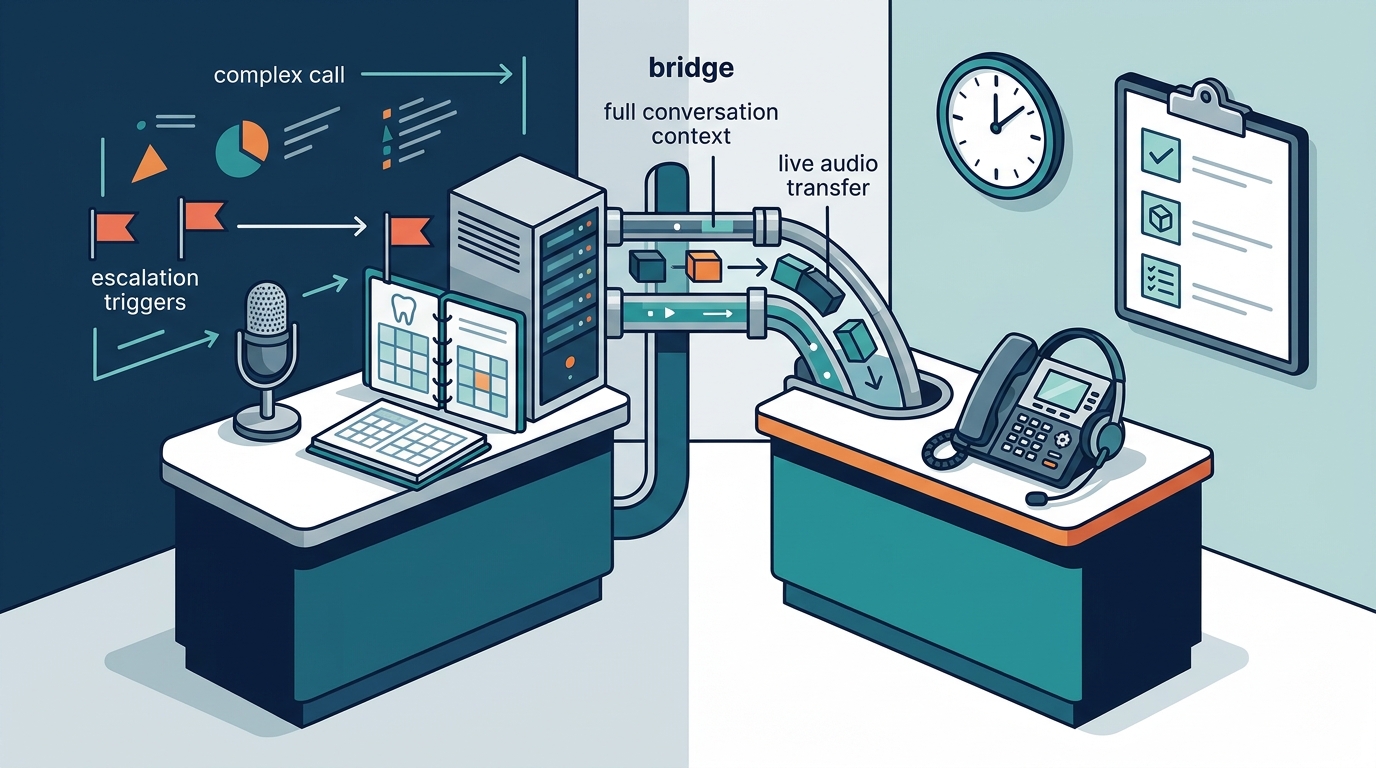
Yes, modern AI platforms provide seamless human handoff for complex dental calls by transferring live audio and full conversation context to a human agent. This guide covers how handoff mechanisms work, how context is packaged and transferred, and the specific clinical escalation rules that protect patient safety and operational efficiency.
Human Handoff Mechanisms
Traditional Interactive Voice Response (IVR) systems route calls based on keypad inputs, often forcing patients to navigate multiple menus before reaching a human. This friction leads to high abandonment rates, particularly for distressed or complex callers. In contrast, an AI voice agent is a conversational interface that uses natural language processing to understand intent and sentiment in real time. The handoff mechanism in a modern platform like CX Bridge is not a simple transfer; it is a dynamic routing event triggered by specific behavioral or semantic signals.
Trigger Identification
The AI agent continuously monitors the call for handoff triggers. These triggers are categorized into three primary groups: emotional escalation, complexity beyond training, and high-value interactions. Emotional escalation is detected when a caller raises their voice, uses profanity, or expresses extreme frustration. The system analyzes tone and sentiment to determine if the situation requires human empathy and judgment.
Warm Transfer Execution
When a trigger is identified, the AI executes a warm transfer. Unlike a cold transfer, which dumps the caller into a queue with no context, a warm transfer involves the AI introducing the human agent to the caller. The AI states the caller's name, summarizes the issue, and explains why the transfer is occurring. This introduction builds trust and reduces the caller's anxiety. The human agent receives the call with a pre-loaded context screen, allowing them to acknowledge the issue immediately without asking the caller to repeat themselves.
Concurrent Call Handling
One of the critical advantages of AI handoff is the ability to handle concurrent calls. A human receptionist can only answer one phone at a time. An AI agent can manage multiple inbound calls simultaneously, answering each on the first ring. If one call requires a human handoff, the AI continues to handle other routine calls, such as appointment bookings or FAQ inquiries, ensuring that no other caller is left on hold or sent to voicemail.
Call Context Transfer
Context transfer is the single most important feature of any AI voice system for dental practices. Without it, the human agent starts from zero, forcing the patient to re-explain their symptoms, insurance details, and history. This repetition frustrates patients and wastes the agent's time. Effective context transfer involves packaging the entire conversation into a structured summary that is displayed on the agent's screen before they speak.
Structured Data Packaging
The AI compiles a context package that includes the caller's name, account details, and a concise summary of the issue. This summary is generated in two to three sentences, capturing the core problem and the caller's emotional state. For example, the AI might note: "Caller is a new patient with severe pain in the lower left molar. They are anxious and requesting an emergency appointment. They have Delta Dental insurance." This structured data allows the agent to prioritize the call appropriately and prepare the necessary resources before the conversation begins.
Real-Time Dashboard Integration
In platforms like CX Bridge Agent Desk, the context package is integrated directly into the agent's dashboard. The agent sees the summary, the full transcript, and any relevant patient history before they pick up the phone. This integration ensures that the agent is fully informed and can provide immediate, accurate assistance. The dashboard also displays sentiment scores, helping the agent gauge the caller's mood and adjust their tone accordingly.
Post-Call Intelligence
Context transfer does not end when the call ends. Post-call intelligence features analyze the entire conversation, including the AI portion and the human portion. This analysis generates a structured report that is pushed to the practice management system or CRM. The report includes the call outcome, any action items, and a sentiment analysis. This data helps the practice track patient satisfaction, identify common issues, and improve their operational processes over time.
Clinical Escalation Rules
Dental practices operate in a regulated environment where clinical judgment is paramount. AI systems must be configured with strict clinical escalation rules to ensure that they do not provide medical advice or make diagnostic decisions. These rules define when the AI must stop handling the call and transfer it to a licensed professional. The goal is to protect patient safety while maximizing the efficiency of the AI for routine tasks.
Defining Clinical Boundaries
Clinical escalation rules are based on the nature of the caller's request. Routine requests, such as scheduling a cleaning or asking about office hours, are handled by the AI. However, requests involving pain, bleeding, swelling, or trauma are flagged as clinical. The AI is programmed to acknowledge the concern, provide basic first-aid guidance if pre-approved, and then transfer the call to a clinical staff member or the on-call dentist. This boundary ensures that the AI remains within its scope of practice.
Emergency Protocols
Emergency protocols are a subset of clinical escalation rules. They are triggered by keywords or phrases indicating a medical emergency, such as "uncontrolled bleeding" or "facial swelling." When an emergency is detected, the AI immediately transfers the call to the highest-priority human agent. The AI also logs the emergency in the system, ensuring that the practice is aware of the situation and can respond appropriately. These protocols are critical for maintaining patient safety and compliance with healthcare regulations.
Compliance and Audit Trails
Every clinical escalation is logged with a full audit trail. This log includes the timestamp, the trigger that caused the escalation, the context package, and the outcome of the call. This audit trail is essential for compliance with healthcare regulations and for quality assurance. It allows the practice to review how the AI handled clinical calls and to make adjustments to the escalation rules as needed. The transparency of this process builds trust with both patients and regulatory bodies.
Comparison of Handoff Approaches
| Feature | Traditional IVR | AI with Cold Handoff | AI with Warm Handoff (CX Bridge) |
|---|---|---|---|
| Context Transfer | None | Basic summary | Full transcript + sentiment + history |
| Caller Experience | Menu navigation, hold music | Repeat information to agent | Warm introduction, no repetition |
| Agent Efficiency | Low (starts from zero) | Medium (some context) | High (pre-loaded context) |
| Clinical Safety | Low (no intelligence) | Medium (basic triggers) | High (advanced escalation rules) |
| Concurrent Calls | Not supported | Limited | Unlimited |
Key Takeaways
- Seamless human handoff is defined by the transfer of live audio and full conversation context, not just a phone transfer.
- Warm transfers reduce caller frustration by introducing the human agent and summarizing the issue before the agent speaks.
- Context transfer packages the caller's name, issue summary, and emotional state into a structured format for the agent's dashboard.
- Clinical escalation rules ensure that AI systems do not provide medical advice, protecting patient safety and regulatory compliance.
- Emergency protocols trigger immediate transfer to high-priority agents when keywords indicating a medical emergency are detected.
- Post-call intelligence analyzes the entire conversation, providing data for quality assurance and operational improvement.
- AI agents can handle concurrent calls, ensuring that routine inquiries are answered while complex calls are transferred to humans.
- Platforms like CX Bridge integrate AI and human agents on a single dashboard, enabling seamless collaboration and shared context.
Frequently Asked Questions
What is the difference between a cold and a warm handoff?
A cold handoff transfers the call to a human agent without providing any context, forcing the caller to repeat their information. A warm handoff involves the AI introducing the agent and summarizing the issue, allowing the agent to acknowledge the problem immediately.
How does AI detect emotional escalation in a dental call?
AI uses sentiment analysis to detect changes in tone, volume, and word choice. If a caller raises their voice or uses frustrated language, the system flags the call for human handoff.
Can AI provide medical advice during a dental call?
No. AI systems are configured with clinical escalation rules that prevent them from providing medical advice. They acknowledge the concern and transfer the call to a licensed professional.
What data is included in the context package?
The context package includes the caller's name, account details, a summary of the issue, the caller's emotional state, and any relevant patient history. This data is displayed on the agent's dashboard before they pick up the call.
How does post-call intelligence benefit a dental practice?
Post-call intelligence analyzes the conversation to generate a structured report. This report helps the practice track patient satisfaction, identify common issues, and improve their operational processes.
Is the handoff process compliant with healthcare regulations?
Yes. Every clinical escalation is logged with a full audit trail, ensuring compliance with healthcare regulations and providing transparency for quality assurance.
Can AI handle multiple calls at once?
Yes. AI agents can manage multiple inbound calls simultaneously, answering each on the first ring. This allows them to handle routine inquiries while transferring complex calls to human agents.
How long does it take to set up AI handoff for a dental practice?
Setup typically takes a few days to a week, depending on the complexity of the practice's workflows. The process involves configuring the AI agent, defining escalation rules, and integrating with the practice management system.
Conclusion
Seamless human handoff is no longer a luxury; it is a necessity for modern dental practices. By leveraging AI platforms that provide warm transfers, detailed context packaging, and strict clinical escalation rules, practices can improve patient satisfaction, reduce operational costs, and ensure compliance with healthcare regulations. CX Bridge offers a robust solution for these needs, enabling AI and human agents to work side by side on a single platform. To see how this works in practice, to discuss your specific requirements.